
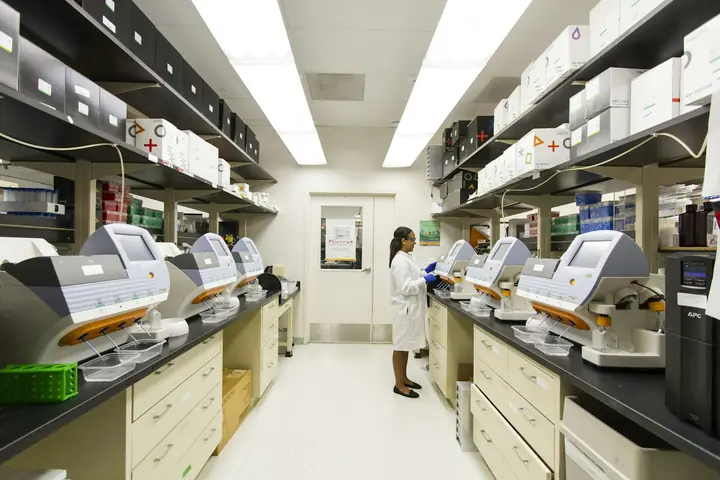
Impurity thresholds are the levels at which an impurity has to be reported, identified or held below a limit. In FDA’s 2026 draft guidance for generic peptide products, impurities above 0.1% are reported and impurities above 0.5% are identified. A purity figure such as 98% says how much of the chromatogram is the main peak. […]
Author Archives: Zubayed F.

11
Oct
Oct
DSIP, delta sleep-inducing peptide, is a nine-residue peptide with the sequence Trp-Ala-Gly-Gly-Asp-Ala-Ser-Gly-Glu, first characterised in rabbits in the late 1970s. It was proposed as a natural sleep factor. A 2006 review reported that no gene, precursor protein or receptor for it had been isolated, and described its role as unresolved. Reading the DSIP literature well […]
11
Oct
Oct
Orthogonal identification means confirming what a peptide is with two or more independent methods that measure different properties. An HPLC retention time and a purity percentage describe how a sample behaved on one column. They do not prove which molecule it is. A certificate that pairs chromatography with mass spectrometry, and with further methods where […]

11
Oct
Oct
TB-500 is a synthetic seven-residue peptide, Ac-LKKTETQ, modelled on a short region of the naturally occurring protein thymosin beta-4. It is the fragment, not the full protein, and the two are not interchangeable in the literature. Most published work on it comes from cell assays, rat models and analytical chemistry. The question that decides how […]